trans: The Big Deal of the Big Toe Extensor
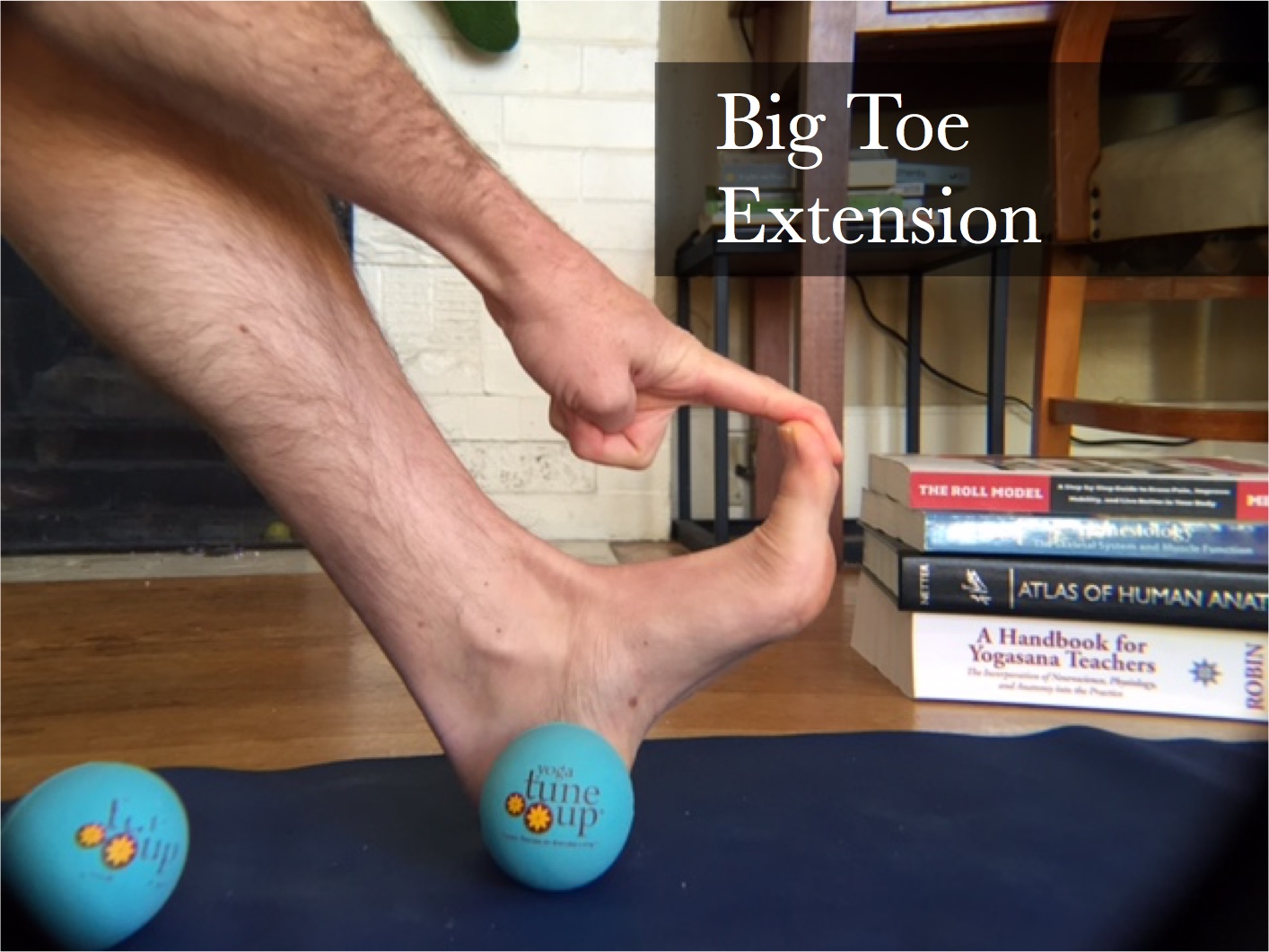
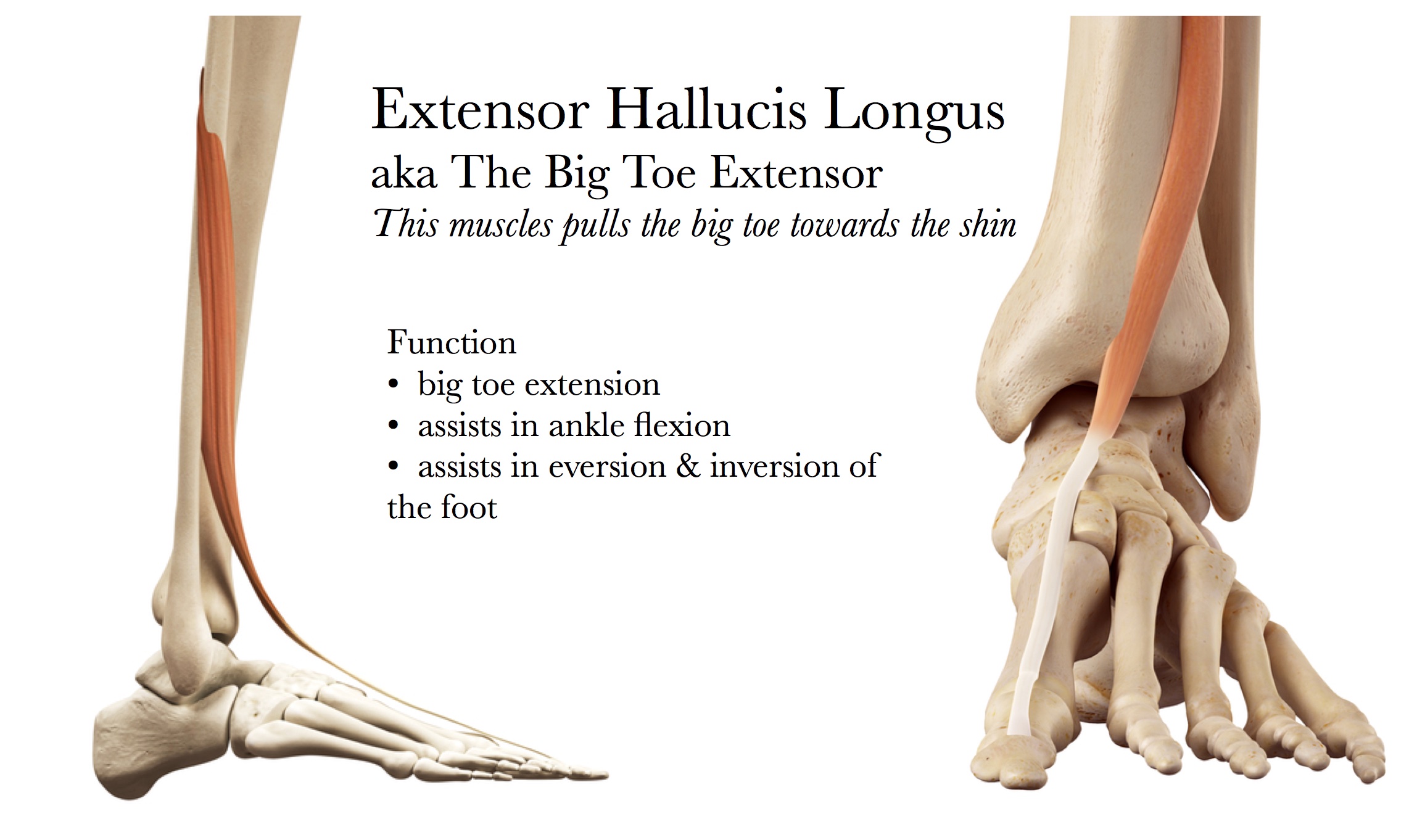
How often do you really consider the role of your big toe in daily living? Probably more often than you think of the one muscle that is responsible for lifting the big toe to your nose: the extensor hallucis longus. We’ll just short-cut the Latin to EHL for ease of reading.
Let’s go a little more apocalyptic with our scenario. What follows is but only one of the infinite possible “hair to heel” disasters. I will heroically place myself at the center of this “Hallux Armageddon.” Hallux is fancy for Big Toe, by the way.
Once upon a time I lost extension of my big toe. My loss was accompanied by a gain: a new and unimproved gait (fancy for walking pattern.) My foot turned slightly out when I walked. At first it was no big deal. However, I had gone from pushing straight off the midline towards pushing off the inside of my foot, which translated to a shearing force across my knee joint. Owie. My body compensated, increasing the external rotation of my hip. My knee was happy but my sacroiliac joint was not. It was compressed in a bad way. So my pelvis tilted back not realizing that the tower of power that is my spine was going to collapse and cause mass hysteria in my central nervous system. The collapse happens. My ribcage crashes forward into my abdominal cavity. My autonomic nervous system, not to be outdone, switches into fight or flight mode and I feel pretty tense, you know? And I notice my neck is sticking out ahead of my entire body like I’m Myrtle the Turtle. And woe betide, my severely shortened stride I can barely extend my hip back when I walk. All of this is due to one muscle and one muscle only: the extensor hallucis longus.
And we didn’t even talk about what happened to my beautifully toned and sculpted butt. But that wouldn’t be fit for print. Glute amnesia is all I’ll say about that (because that’ll be a future blog post.)
That may sound like an exaggeration and, in fact, it is. For one, losing full use of the extensor hallucis longus (the EHL) is a rare occurrence. But decreasing the range of motion – the degree to which we can pull or move the toe towards the shin – this is all too common. And the bad news is that it doesn’t take much range-loss to create what Tom Myers calls a “low velocity, high impact” incident. And this is something to which we are all susceptible.
But don’t fret, Reader. There is hope. Tune in later this week for a little bit more drama as well as some relief. Same Yoga Tune Up® time. Same Yoga Tune Up® channel! But in the mean time, enjoy this Toe Separation Video.
Enjoyed this article? Read Ankles and Toes – Friends or Foes?